
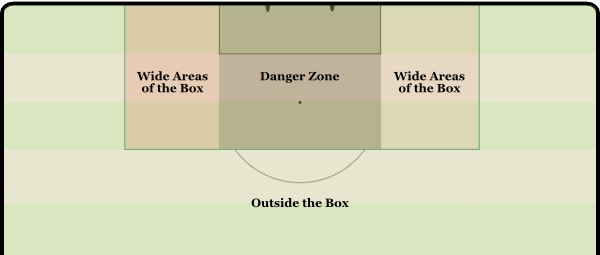
Analyzing where Ligue 1 teams take their shots is often more informative than counting how many shots they take. Shot location shapes goal probability, because a low-volume team that shoots from central, close-range areas can be more dangerous than a high-volume team that settles for long-range attempts. Shooting zones also reveal how a team attacks in practice: whether the team reaches the byline for cutbacks, relies on crosses and second balls, forces shots through crowded central areas, or builds around set-piece routines. For match analysis, shooting zones help you evaluate repeatability, matchup fit, and which defensive weaknesses an opponent is most likely to exploit.
Why Shooting Zones Explain Team Identity Better Than Shot Counts
Shot counts are a blunt measure. Two teams can produce 14 shots, but the first might have 10 shots from outside the box while the second has 6 shots inside the six-yard area. The goal expectation in those two profiles is not comparable. Shooting zones bring the analysis closer to the mechanism of scoring.
In Ligue 1, this matters because many teams defend with compact blocks that concede low-quality shots while protecting central spaces. A team that repeatedly reaches high-value zones despite compact defending usually has stronger attacking structure than a team that accumulates shots without penetrating the box. That is why shooting zones often predict future goals better than recent scorelines.
The Core Shooting Zones That Matter Most in Ligue 1
To analyze shooting zones consistently, you need a shared map. Different data providers use slightly different definitions, but the tactical meaning is stable. The most useful zones are those that separate high-probability finishes from low-probability attempts.
After establishing the idea, the next step is to define the zones in a way that matches how teams actually create chances.
- Six-yard box and immediate central area: highest conversion zone, often from cutbacks and rebounds
- Central penalty area (roughly the “penalty spot corridor”): strong conversion zone, often from through balls and second waves
- Wide penalty area: medium conversion zone, often from tight angles and low crosses
- Outside the box central: lower conversion zone, often from blocked shooting lanes and late shots
- Outside the box wide: generally low conversion zone, often from hopeful attempts after stalled attacks
These zones matter because they reflect whether a team is solving the opponent’s defensive shape or simply shooting because it cannot progress further.
How Team Build-Up Style Shapes Shot Location
A team’s build-up method strongly influences where shots occur. Direct teams that attack quickly often produce shots in the central penalty area because they arrive before the defense is fully set. Possession-heavy teams may take more shots from outside the box because compact blocks reduce central access and force recycling.
In Ligue 1, wide progression is a common workaround against compact defending. Teams that reach crossing zones frequently may generate more wide-area shots or headers, while teams that rely on combination play through the half-spaces may generate more central box shots. Understanding build-up style prevents misreading a shot map as “good” or “bad” without context.
A Practical Method for Comparing Two Teams’ Shooting Zones
Comparing shooting zones becomes useful when it answers a match-specific question: which team is more likely to generate high-quality chances against this particular opponent? That requires looking at both teams’ shot zones and their opponents’ conceded shot zones.
A simple comparison sequence is:
- Identify each team’s most common shot zone in open play
- Check whether those shots are typically created from crosses, cutbacks, or central combinations
- Compare to the opponent’s defensive protection profile (where the opponent allows shots)
- Evaluate whether the matchup increases or decreases access to high-value zones
- Adjust for game state, because leading teams often concede more low-quality shots
This method matters because it keeps the analysis focused on fit. A team with great central shot zones may still struggle if the opponent protects the middle well and forces wide play.
Why Cutback Teams Often Produce the Most Reliable High-Value Shots
Teams that create cutbacks from the byline tend to generate shots from the most valuable zones. A cutback often finds a shooter facing goal near the penalty spot or in the six-yard corridor, with defenders moving toward their own goal and struggling to adjust. This is one reason “byline access” is a strong predictor of shot quality.
In Ligue 1, a cutback-driven team is usually one that can progress wide without losing the ball and has coordinated box occupation, meaning multiple runners arrive at different depths. When those elements exist, high-value shooting zones become repeatable rather than accidental.
A Table That Links Shooting Zones to Tactical Interpretation
Shooting zones become more actionable when you connect them to what they imply about attacking problems or strengths. The table below translates zone-heavy profiles into tactical meaning.
| Dominant Shooting Zone | What It Usually Implies | Common Risk |
| Six-yard box | Strong final-third penetration, good cutbacks/rebounds | Can drop if the opponent blocks wide access |
| Central penalty area | Effective central progression and runner timing | Can be reduced by compact low blocks |
| Wide penalty area | Reliance on tight angles and wide entries | Finishing variance increases, lower conversion |
| Outside box central | Settling for low-quality attempts under pressure | Shot volume hides low expected scoring |
| Outside box wide | Low-probability attempts after stalled attacks | Looks active but rarely converts consistently |
This interpretation helps avoid the common error of praising teams for “shooting a lot” without evaluating whether the shots are worth taking.
When Shooting-Zone Analysis Can Mislead You
Shot maps can be distorted by small samples and unusual match scripts. A red card can force one team into deep defending, leading the opponent to take many low-quality shots. A team that scores early may stop attacking aggressively, lowering its high-value shots in that match while still being structurally capable.
Another misleading pattern comes from set-piece dependence. A team might generate several high-value headers from corners across a short run, making its shot zones look strong, but those chances can fluctuate significantly week to week. Shooting-zone analysis works best when you separate open-play shots from set-piece shots and when you evaluate trends across multiple matches.
Applying Shooting-Zone Insight to Match Selection and Risk
Shooting zones are most useful when they connect directly to decision-making. If one team consistently shoots from high-value central zones and the opponent regularly concedes shots in those same zones, the match has a logical pathway to goals. If both teams mainly shoot from outside the box and both defend the box well, the match may have fewer high-quality chances than reputation suggests.
When comparing fixtures and price ranges on ufabet168, shooting-zone analysis can help you avoid superficial reads. A team with recent goals might still be a low-quality shooter if most attempts come from outside the box, while a team with weak recent finishing might still be structurally dangerous if it repeatedly reaches the six-yard corridor. Using zones as the anchor shifts analysis from outcomes to mechanisms, which improves consistency over a season.
Summary
Analyzing Ligue 1 teams by shooting zones reveals how they actually create danger and how likely their goals are to be repeatable. Shot location is often more informative than shot volume because it reflects whether a team reaches high-value areas like the six-yard box and central penalty zone or settles for low-probability attempts from distance. Build-up style, game state, and opponent defensive structure shape these zones, so the best approach is matchup-based comparison rather than isolated team profiling. Shooting-zone analysis can mislead when samples are small or set pieces dominate, but it becomes a strong filtering tool when used across multiple matches and connected to tactical mechanisms that either create or deny access to the best scoring areas.